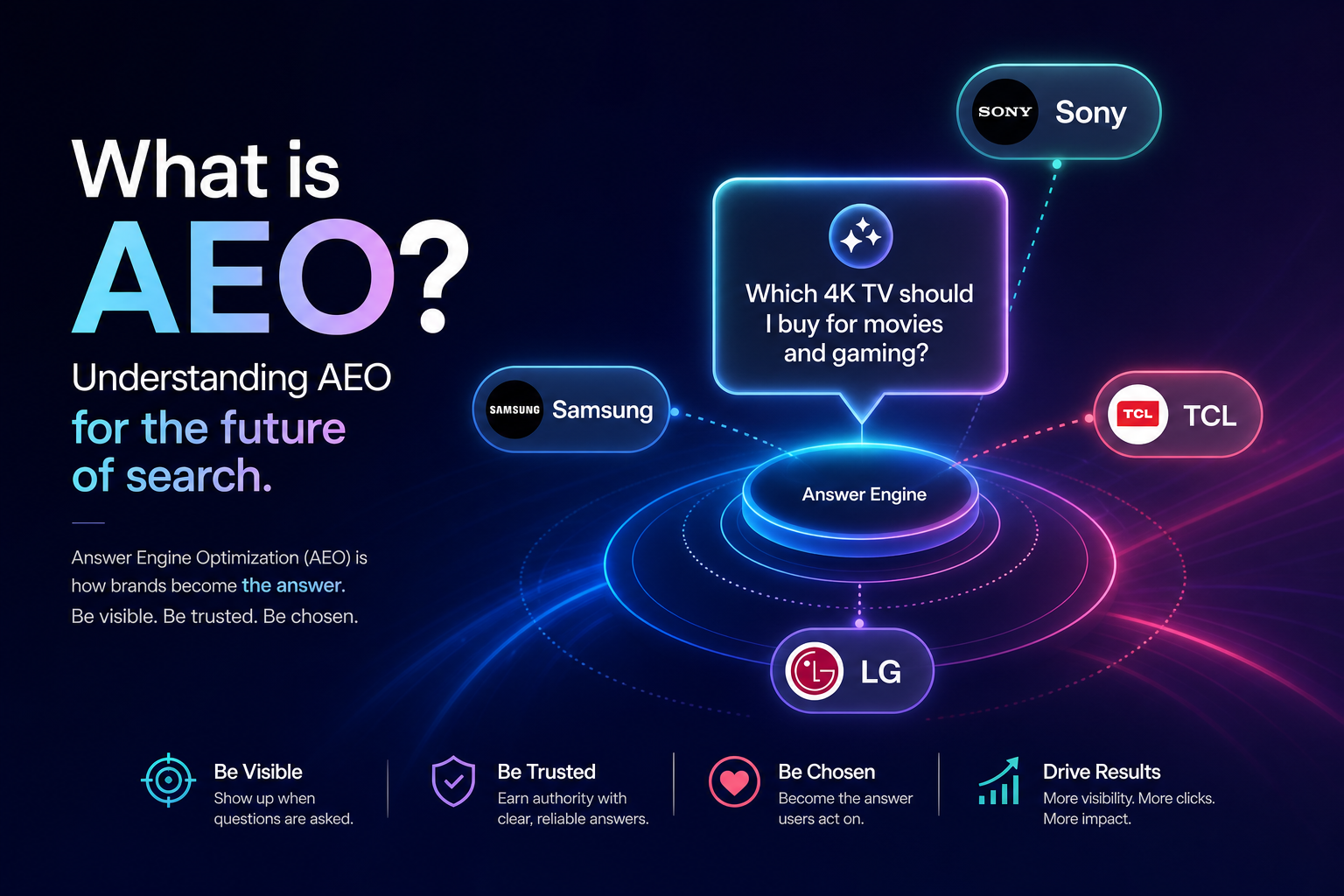
Answer engine optimization (AEO) is the practice of structuring content so AI-powered tools like ChatGPT, Perplexity, Google AI Overviews, and voice assistants can extract, trust, and cite it as the direct answer to a user's query. This playbook shows you exactly how to do it.
Old search put ten blue links in front of a user. New search synthesizes an answer and picks one source to credit. If that source isn't yours, you don't exist in the response. AEO is how you change that.
AEO is how you stay visible in that new reality.
Answer Engine Optimization (AEO) Meaning: A Working Definition for Practitioners
Answer engine optimization is the discipline of engineering content to become the cited source in AI-generated responses. Where traditional SEO aims to rank pages for keywords and drive clicks, AEO targets a different outcome: being selected and mentioned by an answer engine as the authoritative response to a user's question.
The goal is extractability. Your content must be structured for machine parsing, written in natural language that mirrors how people ask questions, and presented with authority signals that help AI systems decide what to trust. Front-loaded direct answers, atomic paragraph structures, schema markup, and fresh citations all feed this goal.
When executed well, AEO positions your brand as the go-to source in conversational search experiences where traditional page rankings become less visible or irrelevant entirely.
Key insight: AEO is not about ranking. It is about being cited.
What Counts as an Answer Engine in 2026?
Answer engines are AI-powered systems that synthesize and deliver responses instead of presenting link lists. They analyze large volumes of information and generate concise, conversational answers rather than requiring users to visit multiple websites.
The core platforms to target:
- ChatGPT (including ChatGPT Search): the largest consumer-facing AI with over 400 million weekly users
- Google Gemini and AI Overviews: Google's AI layer sitting above traditional organic results
- Perplexity AI: a citation-heavy answer engine that surfaces sources explicitly
- Claude (Anthropic): increasingly used for research and long-form query resolution
- Voice assistants: Siri, Alexa, and Google Assistant, all of which pull from synthesized sources
Each platform retrieves and ranks sources differently. Platform-specific tactics matter.
Being Cited by AI Is a Different Problem Than Ranking in Google
AEO in marketing means optimizing content so AI tools can find it, understand it, and use it as the basis for a direct answer. The emphasis is on being selected as a source, not on earning a position in a list of ten blue links.
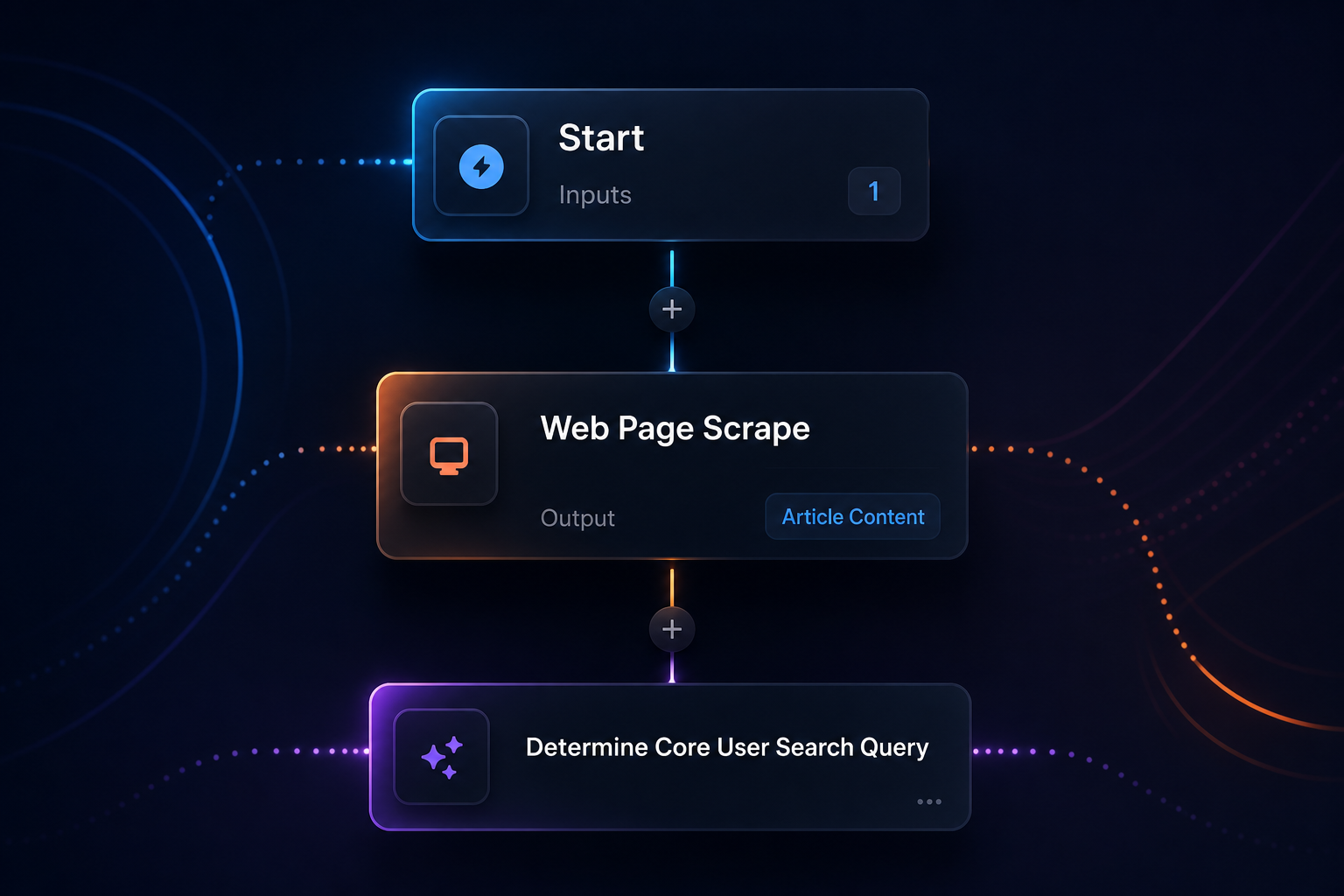
Traditional SEO optimizes for ranking algorithms. You build backlinks, target keywords, and improve page speed so Google puts your URL higher in the results. AEO optimizes for retrieval-augmented generation (RAG) pipelines. AI engines retrieve candidate pages, score them on relevance and trust, then synthesize an answer that cites the most useful sources.
The overlap between these two systems is smaller than most people assume. Research using Ahrefs Brand Radar data across 15,000 prompts found only 12% overlap between AI citations and Google's top 10 results. ChatGPT performs even worse, with just 8% overlap against Google and Bing.
What this means in practice: a page can rank #1 on Google and still be completely absent from the AI answer for the same query. AEO addresses that gap specifically.
How Answer Engines Decide What to Cite
AI answer engines follow a four-stage pipeline when responding to a query.
Retrieve
The system searches its index for pages that are semantically relevant to the query. It pulls candidate documents based on conceptual similarity, not just keyword matching.
Rank
Retrieved pages get scored on relevance, authority, recency, and structural quality. Research analyzing 17 million AI citations found that AI-surfaced URLs are 25.7% fresher than traditional search results, which means answer engines actively favor recently updated content.
Generate
The AI reads the top-ranked sources and synthesizes a response. It pulls facts, data points, and framing from multiple pages.
Cite
The response attributes specific claims to specific sources. This is where your content either earns a citation or gets used without credit (or skipped entirely).
The factors AI engines weigh during ranking include:
- Clarity and directness. Content that answers the question in the first two sentences scores higher than content that buries the answer in paragraph six.
- Structured data. Schema markup (FAQPage, Article, HowTo) helps AI engines parse what your page is about without guessing.
- Trust signals. Author bylines, cited sources, and E-E-A-T indicators all influence whether an AI engine treats your content as authoritative.
- Source diversity. Brands mentioned consistently across multiple trusted domains (G2, industry publications, forums) get cited more frequently than brands that only appear on their own site.
- Freshness. Outdated stats, discontinued product references, and stale examples reduce citation probability.
Why AEO Matters for the Future of Search
The shift is measurable. A Semrush AI search study found that visitors arriving through AI search convert at 4.4x the rate of traditional organic visitors. Gartner projects traditional search volume will drop 25% by the end of 2026. And Google's own CEO has described AI Answers as a way to "do the Googling for you."
Ignoring AI search optimization does not leave you where you are. Your visibility declines as answer engines redistribute attention to sources they trust.
The business case for AEO is clearest in what revenue looks like when AI-mediated discovery works correctly. NerdWallet's revenue rose 35% in 2024 while monthly traffic fell 20%. Discovery and decision-making shifted to AI-mediated experiences, but the brand was present in those experiences. That is the model.
Brands that appear in answer engine results capture mindshare at the moment of intent, before users click anything. Brands that don't appear lose that moment entirely. The cost is not just traffic. It is the decision itself.
Visibility in AI-generated answers is now a revenue channel, not a vanity metric.
How Answer Engine Optimization Differs from Traditional SEO
Traditional SEO optimizes for ranking signals: backlinks, domain authority, page speed, keyword density, click-through rate. These signals tell Google which pages deserve to appear in a list.
AEO optimizes for citation signals: clarity of answer, structural extractability, provenance, and credibility markers. These signals tell an answer engine which source to quote. The measurement changes completely. Instead of tracking keyword rankings and impressions, you track citation rate, AI mention share, and brand presence across AI-generated responses.
Backlinks still matter, but for a different reason. Presence in credible, frequently cited sources signals to answer engines that your content is already trusted by the web. Raw link volume matters less than whether you appear in sources that AI systems already rely on.
Keyword targeting in traditional SEO targets short, high-volume terms and matches them to page content. Conversational query optimization targets the exact phrasing users speak or type into an AI interface: full questions, natural sentence structure, follow-up intent.
The difference is format. A user types "best project management software" into Google. The same user asks ChatGPT "what project management software should a 10-person remote team use?" AEO content is written to answer the second form of the question directly and completely, not to rank for the first.
This requires headings written as questions, opening paragraphs structured as direct answers, and language that mirrors natural speech. Semrush's answer engine optimization research confirms that visitors arriving through AI search convert at 4.4x the rate of traditional organic visitors, which means the query intent is already high when an AI surfaces your content.
The relationship between them is cumulative. SEO gives you the authority and indexation that AI engines rely on when building their source pools. AEO formats that authority into content AI engines can actually extract and use.
Teams that treat them as competing priorities end up doing neither well. Run both. SEO is the foundation. AEO is the format layer on top.
Answer Engine Optimization (AEO) vs Generative Engine Optimization (GEO): Same Work, Different Acronym
The naming debate here is real, but the practical difference is thin.
Answer engine optimization (AEO) emerged when Google started displaying featured snippets and knowledge panels. The goal was simple: structure content so search engines could pull a direct answer from your page.
Generative engine optimization (GEO) is the newer term, introduced as AI chat tools like ChatGPT became primary information sources.
G2 uses "AEO" as the official name for its Answer Engine Optimization software category. Andreessen Horowitz pushed "GEO" in their May 2025 thesis. Fractl's research across 33,000+ marketing job postings and practitioner surveys found 84% of practitioners recognize the term GEO, making it the most widely known label.
Some marketers draw a line: AEO for featured snippets and Google's AI features, GEO for third-party LLMs like ChatGPT and Perplexity. Profound's team argues AEO is the better term because "GEO" conflicts with geography, geology, and geo-targeting. They have a point.
Our position: in 2026, the distinction is academic. The optimization work is the same regardless of what you call it. Structure content clearly, build multi-source authority, add schema markup, and monitor citations across platforms. This guide uses AEO because it's the more specific, less ambiguous term.
Answer Engine Optimization (AEO) and Google AI Mode: Two Surfaces, Two Optimization Strategies
Most teams treat "Google AI" as a single feature. It's actually two distinct surfaces, and they reward different content structures.
AI Overviews appear at the top of search results for many queries. They pull 2-4 cited sources, extract a key fact or passage from each, and display it as a summary. The user often gets what they need without clicking. This is a single-turn surface optimized for fast, concise answers.
AI Mode is conversational. The user asks a question, gets an answer, then asks a follow-up. And another. The engine surfaces sources across each turn of the conversation. A user might start with "What is AEO?" then ask "How is it different from SEO?" then "What tools help with AEO?" and finally "How much does it cost?"
The brands cited across multiple turns earn deeper visibility than brands cited only on turn one.
The practical implication, as Riman Agency's analysis of both surfaces shows, is that you should build "answer modules" on each page. A page with only a definition gets cited on turn one and ignored on turns two through four. A page with a definition module, a comparison module, a cost module, and a how-to module gives the AI four citation candidates across a multi-turn conversation.
Think of each H2 section as a standalone answer that AI Mode might surface independently.

AEO-strategies
Platform-by-Platform AEO Tactics: ChatGPT, Perplexity, Gemini, and Claude
Each answer engine retrieves sources differently. The same content can perform well on one platform and be ignored by another. Platform-specific optimization matters.
Optimizing for ChatGPT and ChatGPT Search
ChatGPT Search retrieves live web content and attributes sources inline. Your content needs to be indexable, structured clearly, and written to answer specific questions rather than describe a topic broadly.
Lead every major section with a 30 to 60-word direct answer. Use question-based headings that match natural phrasing. Maintain updated author bylines and publication dates. ChatGPT Search weighs recency when retrieving sources, so stale content loses ground to newer pages covering the same question.
Optimizing for Perplexity AI
Perplexity retrieves real-time web results and displays numbered citations next to each claim. It rewards content that is specific, data-dense, and structured for easy extraction.
Prioritize: concrete statistics with named sources, short declarative paragraphs, and clear attribution for every factual claim. Perplexity's users are research-oriented. Content written for depth and specificity outperforms content written for broad topic coverage. Being present on authoritative industry sites and news outlets increases your chances of appearing in Perplexity's source pool.
Optimizing for Google Gemini and AI Overviews
Google's AI Overviews draw from the Google index and share retrieval logic with featured snippets. The same structural patterns that earn featured snippets, direct answer paragraphs, numbered lists, Q&A formatting, also earn AI Overview citations.
FAQPage and HowTo schema are the highest-leverage technical investments for this platform. Gemini also weighs E-E-A-T signals heavily. Named authors with verifiable credentials, clear publication dates, and outbound links to primary sources all strengthen your content's position in Gemini's citation pool.
Optimizing for Claude (Anthropic)
Claude relies primarily on its training data, with web retrieval added in some contexts. Optimizing for Claude means building brand presence in sources Claude's training drew from: authoritative publications, industry databases, high-trust editorial outlets, and Wikipedia-adjacent content.
This is a longer-term play. The tactical implication: distribute content to credible platforms rather than keeping everything on your own domain. Being mentioned on sources that Claude has already learned from improves your chances of appearing in Claude's responses, even without real-time retrieval.
The 7-Step Workflow That Makes Content AEO-Ready
Most AEO guides list best practices. Few give you a repeatable production workflow. Here's the one we use.
Step 1: Identify question clusters, not single keywords
AEO targets conversational queries. A single topic like "answer engine optimization" fragments into dozens of related questions when users phrase them naturally in AI tools.
Use Google's People Also Ask boxes, Reddit threads, and ChatGPT's own suggested follow-ups to build a cluster of 10-20 questions around your topic. Group them by intent. Each cluster becomes a page (or a major section within a page), not a separate blog post per question.
Step 2: Write answer-first
Every H2 should get a direct answer in the first 40-60 words. No throat-clearing, no background context, no "before we get into this, let's understand why it matters." Just answer the question.
AI engines extract the first one to two sentences after a heading. If those sentences don't contain the answer, a competitor's sentences will get cited instead.
AISEO's AI article writer generates content in this answer-first format by default, with heading hierarchy and keyword placement built into the output.
Step 3: Make every section independently citable
Each section of your article should make sense if extracted without the surrounding content. AI engines don't cite whole articles. They cite passages. A section that starts with "As we mentioned above..." or "Building on the previous point..." can't stand alone and won't get selected.
Write each H2 block as if it might be the only thing a reader (or an AI engine) ever sees from your page.
Step 4: Add structured data
Schema markup acts as a translation layer between your content and AI parsers. The highest-impact types for AEO are:
- FAQPage schema for any page with question-and-answer pairs
- Article schema with headline, author, datePublished, and publisher
- HowTo schema for step-by-step content
Start with FAQPage on your highest-traffic pages. You can add the others incrementally.
Step 5: Humanize the content
AI answer engines are getting better at detecting and deprioritizing content that reads like it was generated by a language model. Generic, template-driven output that hits every SEO checkbox but sounds like a committee wrote it doesn't earn citations.
The fix is straightforward: content needs to read like a person with expertise wrote it. That means opinions, specific examples, first-hand observations, and sentence patterns that vary in length and structure.
If you use AI to draft content (most teams do), run it through a humanization step before publishing. AISEO's humanization engine rewrites AI-generated text so it reads naturally, which directly affects citation likelihood.
Step 6: Build third-party citations
AI models weight multi-source consensus. If your brand only appears on your own site, AI engines have limited evidence to draw on. If your brand appears across G2 reviews, industry publications, Reddit discussions, and guest posts on credible sites, the signal is much stronger.
Prioritize:
- Guest articles on publications your target audience reads
- Active participation in relevant Reddit and Quora threads
- G2 or Capterra reviews (structured review data feeds directly into LLM training sets)
- Original research that other publications cite
Step 7: Monitor and refresh on a 30-day cycle
AEO measurement is still maturing, but a basic audit is possible today. Every 30 days:
- Query ChatGPT, Perplexity, and Google AI Mode with your 10-20 target questions. Note whether your brand appears, what position it holds in the answer, and which competitors get cited instead. Track changes month over month.
- Refresh high-performing content every 6-12 months. Update statistics, add recent examples, and remove anything outdated. AI engines track content age, and stale pages lose citation priority over time.
Track ChatGPT Visibility with Chat Rank Tracker
AEO work needs measurement. After you optimize a page for direct answers, you need to know whether your brand, content, or competitors appear when users ask relevant questions in ChatGPT. Chat Rank Tracker helps make that check repeatable by tracking prompt-level visibility inside ChatGPT answers.
Use it alongside manual checks in Perplexity, Gemini, and Google AI Mode to understand where your brand is being surfaced, where competitors are winning mentions, and which content gaps should be refreshed next. This turns AEO monitoring from a one-off audit into a recurring optimization loop.
How to Use It in an AEO Workflow
- Choose 10-20 high-intent prompts from your question clusters
- Check whether your brand, page, or competitors appear in ChatGPT answers
- Map missing mentions back to content gaps, weak definitions, or outdated sections
- Refresh the page, then recheck the same prompts on your next 30-day cycle
That process gives your AEO work a feedback loop. You are not just publishing answer-ready content; you are measuring whether it earns visibility in the AI answers your audience is likely to see.
E-E-A-T as a Citation Selection Signal for AI Answer Engines
Large language models use signals similar to Google's E-E-A-T framework (Experience, Expertise, Authoritativeness, Trustworthiness) to evaluate which sources to cite. The parallel is intentional: these models were trained on content that Google had already evaluated for quality.
A page with no author attribution, no publication date, and no outbound citations reads as low-trust to both Google's ranking system and to AI retrieval systems. The signals overlap because the underlying quality signals are the same: does this content come from someone who demonstrably knows the topic, and can I verify it?
Anonymous or pseudonymous expertise has a lower ceiling now. Named, credentialed authors with public track records win citations more consistently.
Tactical Ways to Strengthen E-E-A-T for AEO
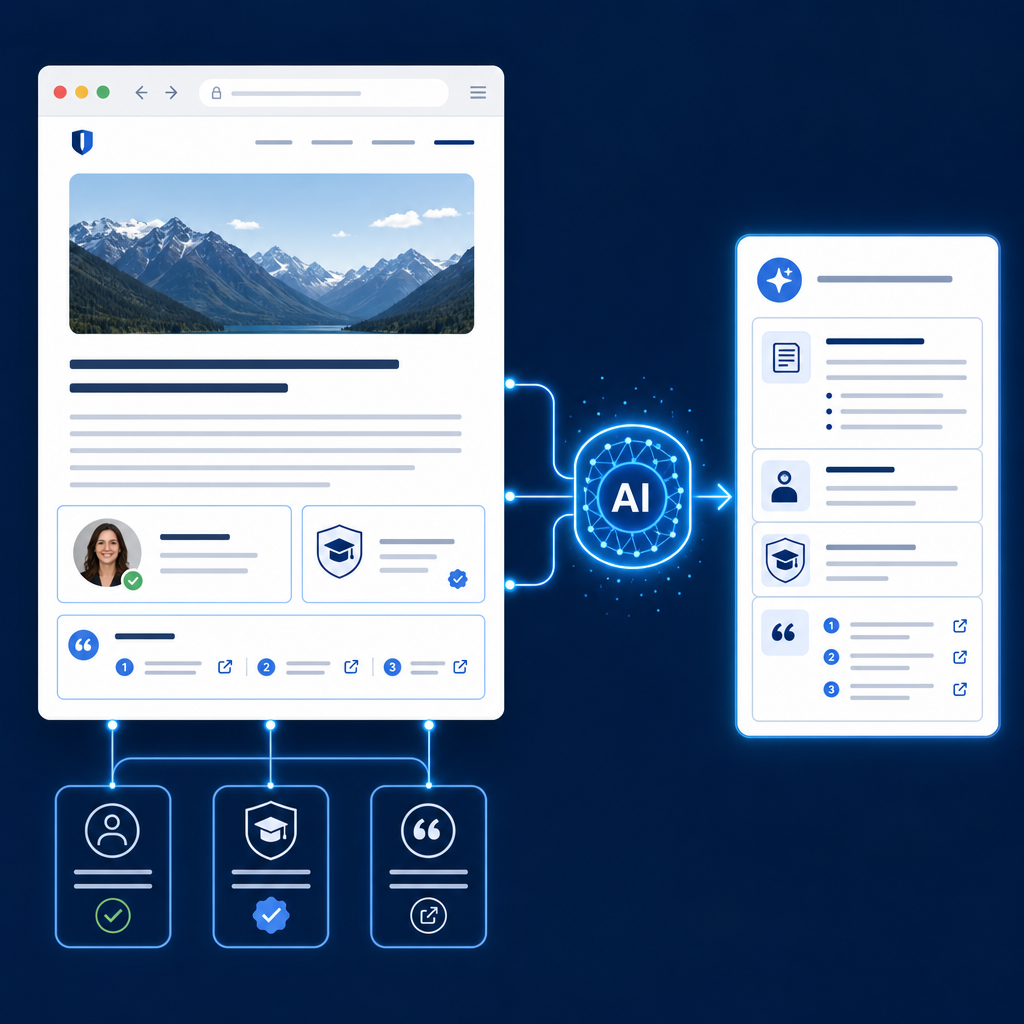
Place a trust block near the top of each page. Include the author's name and credentials, the last updated date, one to two cited sources, and a 40 to 50-word answer summary. This block provides AI systems with clear provenance before they parse the rest of the page.
Practical steps:
- Add a named author byline that links to a bio page with credentials and prior work
- Include the publication date and update date on every page
- Cite at least two primary sources per major factual claim
- Incorporate first-person testing details with specific numbers, dates, or tool versions
- Link out to authoritative sources, not just in to your own pages
Each of these signals lowers the friction for an answer engine to trust and cite your content. Trust becomes a technical asset.
Technical Schema Markup for AEO: FAQ, HowTo, and Speakable
Schema markup is the most direct way to tell answer engines how to use your content. Three schema types matter most for AEO.
FAQ Schema: Structure and Implementation
FAQPage schema marks up question-and-answer pairs so AI systems and search engines can extract them directly. Use it only when your page provides a single, fixed answer to each question. If users can submit alternative answers, QAPage is the correct schema type.
Implementation rules from Google's structured data specification:
- All FAQ content must be visible to users on the source page
- Do not use FAQPage for promotional content
- If the same FAQ appears on multiple pages, mark up only one instance across the site
- Each answer must be direct and complete, not a pointer to find information elsewhere
FAQ schema is the highest-value schema investment for AEO. It creates explicit, machine-readable answer units that AI retrieval systems can extract without ambiguity.
HowTo Schema: Step-by-Step Answer Formatting
HowTo schema structures process-oriented content into discrete, labeled steps. Each step becomes an extractable unit that AI systems can surface independently or in sequence.
Use HowTo schema when your content explains a process with a clear start and end. Name each step explicitly. Include the tools or inputs required. Keep step descriptions to two to three sentences. Voice assistants and AI Overviews preferentially surface HowTo content for procedural queries because the structured format matches the intent directly.
Speakable Schema: Optimizing for Voice and Audio AI
Speakable schema identifies specific sections of a page as suitable for text-to-speech output. It tells voice assistants which content to read aloud in response to spoken queries.
Mark up short, declarative paragraphs that answer a question completely without requiring visual context. Avoid marking up content that references images, tables, or visual elements, since those cannot be conveyed in audio. Speakable is particularly valuable for news content and definitional pages where a spoken summary is the natural response format.
Together, these three schema types create a structured layer that answers engines can navigate efficiently. Schema is not optional infrastructure. It is how you communicate content intent to machines.

AEO Content Audit and Optimization Checklist
A structured audit identifies gaps and prioritizes fixes. Work through these nine steps in order.
Step 1: Map your existing content against real conversational queries. Pull People Also Ask boxes for your core topics. List the exact question phrasing Google surfaces. Compare it against your current headings and page structures.
Step 2: Identify pages with no direct answer in the first 100 words. These are your highest-priority fixes. A page that buries its answer is invisible to answer engines regardless of its ranking.
Step 3: Check for question-based headings. Pages using declarative headings ("Project Management Software") instead of question-based headings ("What project management software should a small team use?") miss conversational query matching. Reformat the highest-priority pages first.
Step 4: Audit paragraph length. Every paragraph should contain one to three sentences. Long blocks of prose are harder for AI systems to parse. Break any paragraph over five sentences into atomic units.
Step 5: Check schema implementation. Verify FAQPage, HowTo, and Article schema are correctly implemented on relevant pages. Use Google's Rich Results Test to confirm markup validity.
Step 6: Evaluate E-E-A-T signals. Does every page have a named author with a linked bio? A publication and update date? At least two cited primary sources? These are baseline requirements, not nice-to-haves.
Step 7: Score pages by gap severity. Pages missing direct answers AND schema AND author attribution are the highest priority. Pages missing only one signal can be queued.
Step 8: Optimize in order. Add direct answer blocks first. Fix schema second. Strengthen author attribution third. Each fix compounds the others.
Step 9: Resubmit updated pages for indexing. Use Google Search Console to request reindexing after significant structural changes. For AI engines outside Google, ensure your pages are crawlable and that sitemaps are current.
Measuring AEO Success: A Named KPI Framework
Traditional SEO metrics don't capture AEO performance. You need a different framework.
Citation Rate: Are You Being Referenced by AI Engines?
Citation rate measures how often your content is referenced as a source in AI-generated responses for your target queries. Test this manually: run your target queries across ChatGPT, Perplexity, and Gemini. Record whether your domain appears as a cited source. Track this weekly against a fixed query set.
AI Mention Share: Your Brand's Share of AI-Generated Answers
AI mention share is the percentage of AI-generated responses for your category that include your brand name, not necessarily as a cited URL. A brand can be mentioned without being linked. Track both. Brand mentions in AI responses influence purchase decisions even without a direct click.
Prompt Visibility Score: Tracking Presence Across Query Types
Prompt visibility score tracks your presence across a diverse set of queries: informational, comparative, transactional, and navigational. A brand that appears only in informational responses has partial AEO coverage. Full coverage means appearing across query types that match your actual customer journey.
Supporting Metrics: Traffic, Brand Search Lift, and Zero-Click Trends
Supporting metrics give context to citation data:
- Branded search volume: rises when AI mentions drive awareness
- Assisted conversions: revenue attributable to AI-assisted sessions before a direct visit
- Zero-click trend: if your organic traffic drops while revenue holds, AI is mediating discovery successfully
- Direct traffic lift: users who heard your brand in an AI response and typed your URL directly
NerdWallet's 35% revenue increase alongside a 20% traffic decline is the clearest illustration of what this measurement picture looks like when AEO works correctly.
Challenges and Emerging Considerations in AEO
Attribution and Measurement Gaps
AEO lacks the tracking infrastructure SEO has built over two decades. Most platforms do not expose citation data via API. Perplexity shows sources explicitly; ChatGPT and Gemini are less consistent. Manual query testing at scale is time-consuming and hard to systematize.
The measurement gap is real. Brands optimizing for AEO are working with incomplete data by definition. The response is to build proxy metrics (brand search lift, direct traffic, assisted conversions) alongside direct citation tracking, and to treat the two data streams together rather than waiting for a perfect attribution model that does not yet exist.
Platform Changes and the Moving Target Problem
Answer engine retrieval behavior changes without notice. A structural change to how Perplexity ranks sources, or a shift in how Gemini weights schema, can alter citation patterns overnight. Unlike Google algorithm updates, which are often announced or documented, AI platform changes are rarely telegraphed.
The practical implication: build content quality as the stable foundation rather than optimizing narrowly for one platform's current behavior. Content that is well-structured, accurately cited, clearly attributed, and written for genuine human utility performs across platform changes better than content optimized for a specific retrieval quirk. CXL's complete AEO guide covers additional tactics for building this kind of platform-resilient content.
How AISEO Makes Content AEO-Ready from the Start
Most AEO tools focus on monitoring: tracking where your brand appears in AI answers and how often competitors get cited instead of you. That data is valuable. But it only tells you where the gaps are. It doesn't fill them.
AISEO sits on the other side of the problem. It's a content creation tool built for the same workflow described above.
The AI article writer generates structured, SEO-optimized content with answer-first formatting, heading hierarchy, and keyword integration. The blog creator handles longer-form content production at scale. And the humanization engine ensures the output sounds like a subject-matter expert wrote it, not a template.
We also have some other niche tools that can help you get the most out of your answer engine optimization (AEO) efforts, including but not limited to:
- Reddit Agent: Get your brand mentioned across Reddit communities.
- Outrank Article: Outrank Article is built for anyone looking to win traffic without reinventing the wheel. It takes what's already working and makes it better.
- AI Engine Optimizer: Transform your blog posts with our AI-powered optimization tool designed to improve visibility and ranking on Google..
On G2, AISEO holds a 4.6/5 rating across 630 reviews and is listed under both the AI Writing Assistant and Answer Engine Optimization categories. That dual listing reflects what the tool does: it bridges content creation and AEO in a single workflow.
If you're already using a monitoring tool like Profound, Airefs, or Otterly to find visibility gaps, AISEO is the execution layer that helps you close them. If you're starting from scratch, it handles steps 2, 3, and 5 of the workflow above out of the box.
For a deeper look at how G2's AEO category data reveals visibility gaps and where content quality still wins, see our AEO insights from G2 analysis.
FAQ
What is AEO in marketing?
AEO in marketing is the practice of optimizing content so AI-powered platforms cite it as a source when generating answers. It applies to any brand whose buyers use ChatGPT, Google AI Mode, Perplexity, or similar tools to research products, compare options, or find solutions. AEO focuses on earning citations in AI-generated answers rather than earning clicks from search result links.
What is the difference between AEO and GEO?
AEO (answer engine optimization) and GEO (generative engine optimization) describe the same discipline. AEO originated with featured snippets and voice search. GEO emerged as a label for optimizing content for LLMs like ChatGPT. In practice, the strategies are identical: structure content clearly, build authority across multiple sources, add schema markup, and monitor AI citations. G2 uses "AEO" as the official category name, while some venture capital firms and marketing platforms prefer "GEO."
Does AEO replace SEO?
No. AEO depends on SEO fundamentals like technical health, domain authority, crawlability, and backlinks. Research shows 99% of URLs in Google AI Mode appear in the top 20 organic results, meaning strong SEO correlates with AI visibility. The difference is that ranking alone doesn't guarantee citation. AEO adds the formatting, structure, and trust signals that AI engines need to select your content as a source.
What workflows help ensure content is AEO-ready?
An AEO content workflow includes seven steps: identify question clusters (not single keywords), write answer-first with direct responses in the first 40-60 words, make each section independently citable, add structured data (FAQPage, Article, HowTo schema), humanize AI-generated content so it reads naturally, build third-party citations through digital PR and community participation, and run a 30-day citation monitoring cycle. The key shift from SEO workflows is treating every section as a standalone answer that AI might extract independently.
How do you measure AEO success?
AEO success metrics differ from traditional SEO. Track AI citation frequency (how often your content appears as a source in AI answers), brand mention volume across AI platforms, share of voice relative to competitors, and sentiment (whether AI frames your brand positively or negatively). Use manual testing on ChatGPT, Perplexity, and Google AI Mode for your target queries. Filter GA4 referral traffic by sources like chat.openai.com and perplexity.ai to measure AI-driven visits. Purpose-built tools from providers like Profound, Airefs, and Otterly automate this monitoring at scale.
About the Author

Dilyar Buzan is the founder and CEO of AISEO.ai, an AI-native SEO platform. With a background in AI from the University of Amsterdam, Dilyar specializes in Generative Engine Optimization (GEO), Answer Engine Optimization (AEO), and AI-driven content strategy, helping brands earn visibility across ChatGPT, Perplexity, Google AI Overviews, and traditional search. He's also co-founder of Sceneform.ai, an AI content platform for brands and creators.